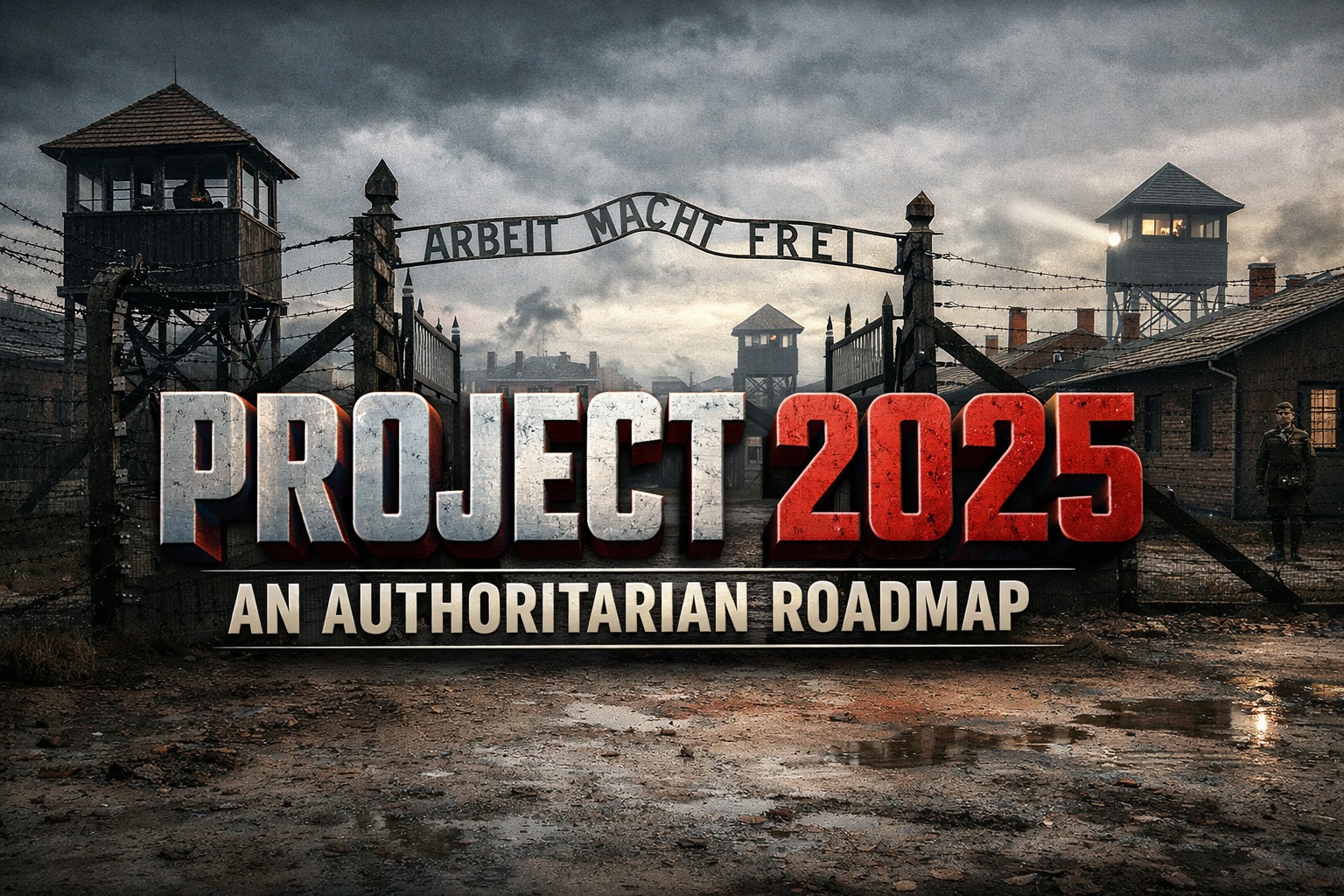
Project 2025: An Authoritarian Roadmap
Project 2025 is not a slogan. It is a governing playbook. It lays out how a future conservative administration can seize day-one control of the executive branch and drive sweeping policy change across government. The effort is organized by The Heritage Foundation with a large coalition of partners. Its anchor text is a 900-plus page book, Mandate for Leadership: The Conservative Promise. The document spells out a plan to “deconstruct the Administrative State,” build a loyal personnel pipeline, and execute an aggressive first-180-days agenda.
The pitch is simple. Staff up with ideologically vetted loyalists. Rewrite rules that limit presidential control. Move fast inside agencies. Restructure or gut programs that do not fit the movement’s agenda. The stakes are high because the plan targets both policy and power. It changes not only what the government does, but who decides. (The Heritage Foundation)
What Project 2025 Is
Project 2025 is a presidential transition project with four pillars. Pillar I is the policy book. Pillar II is a personnel database that functions like a private talent portal for a new administration. Pillar III is a training pipeline called the Presidential Administration Academy. Pillar IV is a tactical “Playbook” to coordinate agency moves in the opening months. Together, these pillars aim to deliver a ready-to-go government in a box. (The Heritage Foundation)
The coalition behind it is broad within the conservative movement. Heritage announced at least 60 advisory partners in 2023 and has continued to add more. The project describes hundreds of contributors and authors. Its leaders include Paul Dans and Spencer Chretien. The goal is explicit: produce aligned people, aligned plans, and a rapid execution script for Day One. (The Heritage Foundation, Heritage Foundation)
Major outlets confirm the project’s scope. Reuters and AP describe Project 2025 as an extensive policy blueprint written by prominent conservative figures that supporters want a Republican White House to adopt. They also note widespread public attention and controversy. (Reuters, AP News)
The Core Power Agenda
The first agenda is about power. The text and the surrounding advocacy seek stronger presidential control over the entire executive branch. The strategy relies on three mechanisms.
First, personnel. The plan builds a database of loyalists and trains them to run agencies with ideological focus. It states plainly that the goal is to “deconstruct the Administrative State.” That line is not rhetorical. It sets the intent for everything that follows.
Second, legal architecture. The book promotes reinstating and expanding “Schedule F,” a 2020 executive order that would reclassify tens of thousands of civil servants into at-will roles. That change strips job protections and lets the White House replace career experts with political appointees across policy-shaping positions. Multiple chapters cite Schedule F by name and call for its return. Independent reporting explains the effect and scale. (Reuters)
Third, control over traditionally independent bodies. The broader ecosystem around Project 2025 pushes greater presidential supervision of agencies that have been insulated from direct White House control. In 2025, the White House issued an executive order aimed at asserting “Presidential supervision and control of the entire executive branch,” which outside coverage describes as tightening the grip over independent agencies such as the FTC and FCC. This shows the model in action: use executive power to pull more levers into the West Wing. (The White House, Reuters)
Civil-society experts warn that these moves would erode checks inside the executive branch. The Brennan Center calls this “a blueprint for a vast expansion of presidential power.” The ACLU frames it as a civil-rights threat that would be fought in court. These are advocacy perspectives, but they reflect a consensus concern across watchdog groups. (Brennan Center for Justice, American Civil Liberties Union)
The Execution Agenda: A 180-Day Blitz
Project 2025 does not only sketch ideas. It instructs teams to draft transition plans and prioritize early actions. The idea is to avoid past delays, fill key jobs with trained loyalists, and drive rulemaking and executive orders immediately. The book’s foreword describes building teams that will “move out upon the President’s utterance of ‘so help me God.’” That is a pledge to strike fast.
Below are the key policy agendas that recur across chapters.
Justice Department: Reorient Priorities and Expand Political Control
The Department of Justice chapter argues that DOJ has “lost its way” and should be refocused on public safety and a narrow reading of the rule of law. It calls for reorganizing responsibilities, including moving some election-crime work, and changing how civil-rights laws are enforced. The broader plan is to align DOJ leadership and enforcement with the President’s program. Reuters reporting describes allied plans to use legal authorities to bring in more political appointees and outside personnel. (Reuters)
The risk is clear. If you combine Schedule F with an ideologically filtered personnel pipeline, you get a Justice Department that answers to the President first and to neutral enforcement standards second. That places political incentives over independent prosecutorial judgment, especially on sensitive matters like voting rights, protest, and oversight. The Brennan Center warns that such a vision would weaken guardrails built after Watergate. (Brennan Center for Justice)
Homeland Security and Immigration: Structural Change and Maximal Enforcement
The Homeland Security chapter goes beyond routine reform. It entertains a “dismantling recommendation” for DHS as a department, with redistribution of its components to other Cabinet agencies. Short of that radical move, it calls for deep internal reorganization. DOJ and DHS sections also push harder immigration enforcement through coordinated prosecution and rulemaking.
This is not abstract. The method is to realign enforcement, rule changes, and prosecutions to speed removals and limit humanitarian protections. The DOJ text urges aggressive use of immigration authorities in partnership with DHS. In practice, such moves can produce mass processing systems with less review, fewer waivers, and more detention. Civil-liberties groups have announced litigation strategies against mass-deportation drives, which shows how quickly these agendas trigger rights conflicts. (Axios)
Education: Shrink Federal Role, Move Civil-Rights Enforcement, and Cut Programs
The Education chapter by Lindsey Burke proposes a sharp reduction of the federal footprint. It recommends eliminating or moving many programs to other departments, block-granting funds, and aggressively paring back the Office for Civil Rights at the Department of Education. It explicitly recommends moving OCR to the Justice Department and rolling back Title IX interpretations that protect LGBTQ students. It outlines budget cuts and program eliminations as tools to retrench federal influence.
Independent coverage has highlighted that Project 2025 aligns with efforts to weaken or even dismantle the Department of Education and to condition school funding on cultural litmus tests. While the project’s text uses administrative language, the effect would be large: fewer civil-rights investigations, a rollback of guidance, and more discretion left to states and districts without federal guardrails. (The Guardian)
Health and Human Services: Reproductive Policy, Gender Policy, and Civil-Rights Enforcement
The HHS sections, including contributions by Roger Severino, target abortion, conscience rules, and the federal interpretation of nondiscrimination law. The text urges reversing guidance under Section 1557 of the Affordable Care Act that protects LGBTQ patients, and it criticizes federal guidance on gender-affirming care and reproductive-health privacy. The document also promotes changes to Title X and related programs. These moves shift federal policy toward restricting access and narrowing civil-rights protections in health care.
This is a direct clash with policies issued in recent years that interpret sex discrimination to include gender identity and sexual orientation. The plan would pull the federal government in the opposite direction and would elevate conscience-based refusals. The litigation risk is high because courts will have to reconcile statutory text, medical practice, and prior regulations with new rules. Civil-liberties groups are preparing those challenges now. (The Guardian)
Environment and Energy: Strip Climate Authority and Roll Back Rules
Project 2025’s environmental approach favors deregulation and industry flexibility. The EPA chapter and related movement materials argue for shrinking environmental-justice initiatives and revisiting foundation rules. In 2025, the administration moved to rescind the EPA’s “endangerment finding,” which underpins greenhouse-gas regulation, and to rip out vehicle and power-plant emissions limits. Those actions illustrate the Project 2025 model: reinterpret legal authority, withdraw rules, and weaken enforcement. Business coverage warns of regulatory whiplash and investment risk. (Reuters)
If you erase the legal basis for climate rules, the entire system of national standards collapses. That drives uncertainty for automakers, utilities, and states that must plan decades ahead. It also shifts costs onto communities that face extreme weather, pollution, and health harm. Courts are already hearing challenges over climate-related grants and rule withdrawals. The cascading effect will be fewer safeguards and slower clean-energy investment. (Reuters)
State Department and Foreign Policy: Ideological Realignment
The State Department chapter, authored by former policy-planning chief Kiron Skinner, calls for structural changes and a more ideological posture on international institutions, human rights framings, and multilateral funding. It recommends personnel and organizational shifts to align diplomacy with administration priorities. Read in concert with the broader personnel agenda, this would produce a diplomatic corps filtered more by ideology and less by career expertise.
The risk is not only policy direction. It is a hollowing out of independent analysis. When ideological screening dominates hiring and promotion, complex issues like alliances, sanctions, and global health can become tools of domestic politics. That weakens credibility abroad. It also invites retaliation from adversaries who exploit partisan swings.
Elections and Democratic Guardrails: Enforcement Shifts with Systemic Effects
The DOJ chapter proposes changes to election-related enforcement. It criticizes past approaches to voter-suppression oversight, and it urges relocating parts of that work. It argues for stronger prosecution of certain election offenses while downplaying other areas, which would reorder federal attention. Watchdog groups warn this can create selective enforcement and chill local officials. The Brennan Center’s series on Project 2025 details risks to election administration and cyber security when federal guardrails are weakened. (Brennan Center for Justice)
Combine this with the push for more presidential control over independent agencies, and the concern deepens. If a President can influence the FEC or related rulemaking more directly, campaign enforcement can tilt toward partisan priorities. Ongoing court fights over executive orders that assert control over independent regulators show the legal stakes and the uncertain future of agency independence. (Reuters, Financial Times)
The Social Agenda Around the Project: Pronatalism and Cultural Policy
Heritage has been advancing a broader pronatalist vision that calls for a “Manhattan Project” for more babies within traditional marriages. The ideas include redirecting child-care funding, re-engineering tax incentives, and ordering executive policy reviews through a “family impact” lens. This is not a formal chapter of the Mandate text, but it shows where the movement is going on social policy in 2025 and beyond. It aligns with the desire to use federal power to reshape private life and culture. (The Washington Post)
When you combine this with the Project 2025 education and health agendas, you see a through-line. Centralize federal power in the White House. Move civil-rights enforcement away from education agencies. Narrow reproductive and LGBTQ protections. Then use fiscal and regulatory tools to reward one family model. The result is not small government. It is strong government that prefers one way of life.
Who Benefits, Who Runs, and How It Operates
Project 2025 is designed to benefit an administration that shares its aims and to empower movement-aligned organizations that help fill government roles. Heritage coordinates the network, curates the personnel database, and trains candidates for appointment. The Mandate book lists editors, authors, and contributors across think tanks and advocacy groups. Reuters and AP coverage confirm that Project 2025’s designers want a friendly White House to pick up the plan and run with it, even as political actors sometimes distance themselves from the brand. (The Heritage Foundation, Reuters, AP News)
The intended operators are not just Cabinet secretaries. They are assistant secretaries, general counsels, policy advisers, and regulatory staff across agencies. The power agenda ensures they are easier to appoint and harder to dislodge. Schedule F is the key. It converts expert roles into political ones. That is why so many Project 2025 chapters reference it directly.
Why This Is Dangerous
It collapses internal checks. Merit-based civil service protections exist to prevent partisan purges that sandblast institutional memory and technical expertise. Reclassifying policy-shaping roles through Schedule F would let any president remove career staff en masse. The effect is a spoils system at scale. That invites cronyism, weakens continuity, and deters whistleblowing. Legal analysts warn that this reclassification would destabilize the professional civil service and upset constitutional balances. (Reuters, State Court Report)
It concentrates power in the White House. Pulling independent agencies closer to presidential control erases barriers that shield markets and rights from political swings. The executive orders and litigation around independent agencies in 2025 demonstrate both the ambition and the risk. When one office can move budgets, rulemaking calendars, and enforcement priorities across the government, the temptation to weaponize policy is strong. Courts now face that question. The outcomes will shape agency independence for years. (Reuters)
It narrows civil-rights protections. Moving Education’s civil-rights office to DOJ and rolling back Title IX interpretations will reduce federal protections for LGBTQ students and limit oversight of discriminatory discipline. Health policy changes will make it easier for providers to deny care and harder for patients to assert rights under federal law. The costs will fall on those with the least power in schools, clinics, shelters, and workplaces.
It weakens climate and public-health safeguards. If EPA’s authority rests on the endangerment finding, then ripping it out collapses standards that protect air, water, and climate. Businesses hate uncertainty. Communities suffer the health burden. Courts are already handling disputes over rescinded grants and rules. The long-term cost will include more disease, more disaster damage, and lost competitiveness in clean industries. (Reuters)
It politicizes justice and elections. Shifting DOJ priorities on election enforcement and civil-rights oversight risks selective policing of political life. That chills participation. That increases conflict at the polls. When the same plan also empowers the President over quasi-independent regulators, the feedback loop is dangerous. The referees can become players. (Brennan Center for Justice)
It speeds everything up. The Playbook model makes shock therapy a feature, not a bug. The first 180 days are designed for maximum throughput before Congress, courts, or the public can absorb the changes. That tempo reduces transparency and public input. It converts the regulatory state into a blitz state.
What to Watch Next
Courts will decide how far executive control can reach. Reuters reports that the Supreme Court is now weighing cases on removal power and emergency authorities that will set boundaries for this presidency and any next one. Those rulings will determine whether independent agencies remain truly independent and how fast a White House can reorder government. (Reuters)
Congress will face a stark choice on civil service and climate authority. Lawmakers can codify protections against Schedule F, or they can permit large-scale politicization of policy roles. They can preserve EPA’s climate authority, or they can allow a patchwork of state rules and industry uncertainty.
States, cities, and civil society will become the front line. The ACLU and allied groups are preparing litigation on deportations, health-care discrimination, and free-speech retaliation. Universities, school districts, and hospitals will have to decide whether to comply with new rules or fight them in court. (The Guardian)
Bottom Line
Project 2025 is a governing manual that uses structure to produce outcomes. It builds a cadre. It changes the rules that restrain a president. It then channels that power into education, health care, immigration, environment, and elections. The plan is coherent. The plan is fast. The plan is designed to be hard to reverse.
That is why it is dangerous. It replaces neutral expertise with partisan loyalty. It narrows civil-rights enforcement where communities need it most. It undercuts climate safeguards that protect health and the economy. It blurs the line between independent rules and presidential will. It does all of this while the public is still waking up to its scope.
A healthy republic needs time, transparency, and independent checks. Project 2025 shortens the time, hides the process inside personnel, and strips the checks. That is not prudence. That is power for its own sake.
REFERENCES
- Mandate for Leadership: The Conservative Promise (Project 2025), including its four pillars, its “deconstruct the Administrative State” pledge, its Schedule F references, and its agency chapters on Education, HHS, DOJ, DHS, EPA, and State.
- Heritage explanations of the personnel database and training academy. (The Heritage Foundation)
- Coalition size and leadership announcements by Heritage. (The Heritage Foundation)
- Reuters and AP explainers on what Project 2025 is and why it matters. (Reuters, AP News)
- White House actions and legal coverage in 2025 that exemplify the push to assert presidential control over independent agencies. (The White House, Reuters)
- Brennan Center and ACLU analyses of the civil-liberties and separation-of-powers risks. (Brennan Center for Justice, American Civil Liberties Union)
- Reporting on EPA climate rollbacks and legal fights over the endangerment finding and emissions rules. (Reuters)
- Washington Post reporting on Heritage’s 2025 pronatalist push, which shows the movement’s expanding social project. (The Washington Post)
Paid for by Civic Lightworks (FPPC ID 1483541)
Disclosure: This article was written by Civic Lightworks with A.I. assistance for research and editorial support. While the author believes the content is accurate, readers are responsible for verifying information and should seek professional guidance before making legal, financial, or other decisions.