Project 2025: Similarities with Hitler’s Mein Kampf
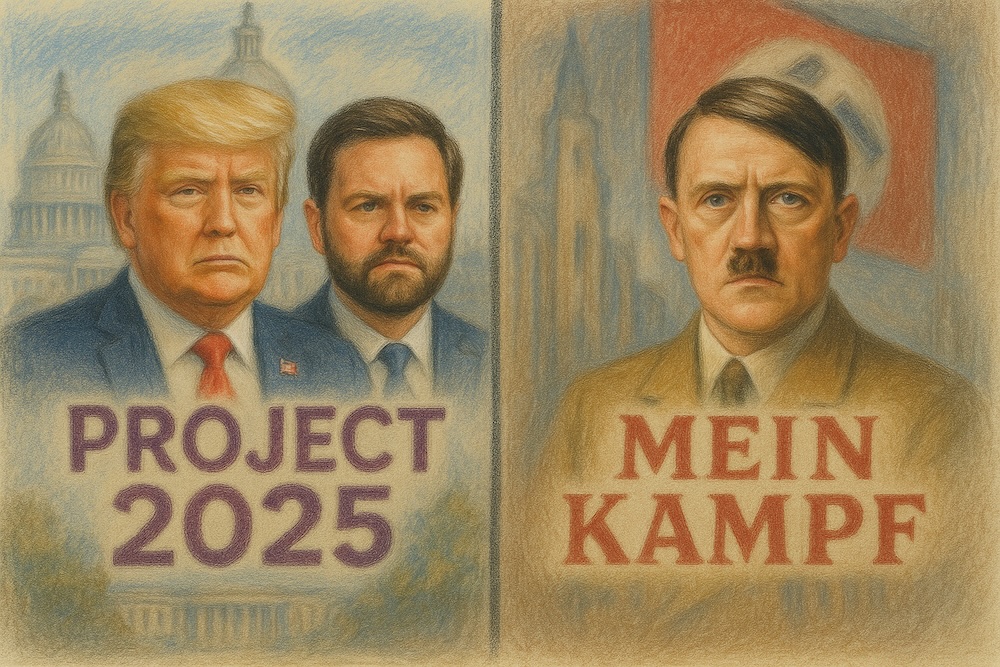
Historians, legal scholars, and commentators have noted troubling echoes between themes in Adolf Hitler’s Mein Kampf and the contemporary Blueprint known as Project 2025. These echoes do not imply that Project 2025 is a fascist text in the same class as Mein Kampf, but rather that certain policy proposals and rhetoric reflect aspects of authoritarianism and authoritarian-leaning governance.
This essay will explain what each work is, outline fascism’s defining features, and then compare where Mein Kampf and Project 2025 overlap in ideas such as centralized power, erosion of pluralism, cultural control, and threat narratives. The goal is a sober, fact-checked analysis, not exaggeration, to help readers understand modern threats to democratic institutions.
What Are We Comparing?
Mein Kampf
Adolf Hitler’s Mein Kampf (My Struggle), written in the 1920s and published in 1925, laid out his antisemitic worldview, anti-parliamentarianism, and ultranationalist ideology. It frames Jews and Marxists as existential enemies of Germany and promotes a fascist totalitarian future based on racial purity, national expansion, and absolute leadership. It justified the Nazi program that led to the Holocaust and World War II (Wikipedia, Encyclopedia Britannica).
Project 2025
Published by The Heritage Foundation in April 2023, Project 2025 (also known as the Presidential Transition Project) is a comprehensive 900-page policy blueprint and personnel plan to reshape the U.S. executive branch around conservative principles. It proposes consolidating executive power, politicizing the civil service, dismantling various federal agencies, restricting rights for marginalized groups, and reshaping culture and education (Wikipedia, CBS News).
Defining Fascism
Before comparing the two texts, it is helpful to understand what scholars identify as fascism.
- Robert Paxton defines fascism as political behavior marked by “obsessive preoccupation with community decline, humiliation, or victimhood,” paired with unity, energy, redemptive violence, and abandonment of democratic liberties in pursuit of internal cleansing and conquest (Wikipedia).
- Umberto Eco lists recurring features of “Eternal Fascism,” including scapegoating outsiders, fear of difference, obsessive nationalism, and suppression of dissent (Wikipedia).
- Fascist repression often includes cultural control, scapegoating, populist nostalgia, erosion of rule of law, and hyper-masculine family norms (Wikipedia, Encyclopedia Britannica).
Similarities Between Mein Kampf and Project 2025
1. Centralized, Dictatorial Power
- Mein Kampf advocates for total control by a central leadership, disdains parliamentary systems as corrupt and opportunistic, and frames Germany’s parliamentary democracy as inherently weak and controlled by Jewish or Bolshevik interests (Wikipedia).
- Project 2025 similarly proposes dismantling merit-based civil service and replacing it with loyalist appointees; consolidating control over independent agencies like DOJ, FBI, EPA, and DOE under a unitary executive; and restructuring the federal government to answer directly to the presidency (Wikipedia, People.com). Critics warn this amounts to democratic backsliding (Wikipedia).
Both texts therefore share an authoritarian impulse toward centralized executive control at the expense of institutional checks and balances.
2. Scapegoating and Threat Framing
- Mein Kampf frames Jews, Social Democrats, and parliamentary politicians as deliberate threats to the nation. Hitler uses the idea of the “Jewish peril” as a central conspiratorial motif (Wikipedia).
- Project 2025 does not target a specific ethnicity but frames “woke propaganda,” LGBTQ rights, diversity programs, DEI, and federal interference in education and culture as existential threats to “the American family,” traditional values, and national cohesion (The Washington Post, People.com, Wikipedia).
While less overtly genocidal, Project 2025 employs threat imagery to justify cultural suppression and institutional reconfiguration.
3. Control Over Culture, Family, and Identity
- In Mein Kampf, Hitler employs ideology to reshape German identity around racial purity, masculine virility, nationalist pride, and anti-liberal culture.
- Project 2025 proposes government-backed measures to promote heterosexual marriage and fertility, restrict access to abortion, ban pornography, curtail LGBTQ protections, roll back DEI, and reshape education around Christian nationalist values (The Washington Post, People.com, Wikipedia, Vogue). The blueprint explicitly encourages executive orders to measure government policies by their impact on families (The Washington Post).
Both texts elevate culturally conservative norms, with policymaking aimed at reinforcing traditional family structures and suppressing alternative identities.
4. Erosion of Institutional Democracy
- Hitler’s text seeks to tear down democratic institutions and install a Führer-led system, justified by ideology and party.
- Project 2025 proposes systematic weakening or abolition of agencies such as Education, Homeland Security, the EPA, and reorganizing or centralizing others. It also discourages enforcement of civil rights protections, limiting federal oversight in favor of ideological policing (Wikipedia, People.com).
These steps reflect institutional erasure to make way for ideological governance rather than impartial public service.
5. Use of Force and Law Enforcement
- In Mein Kampf, Hitler outlines the use of political violence and paramilitary action to consolidate control.
- Project 2025 weighs using the Insurrection Act and military resources for border enforcement and suppression of dissent. It recommends prosecuting selective groups, empowering DOJ over civil rights enforcement, and enabling military or law enforcement intervention in domestic matters (Wikipedia, TIME).
Though not identical, both texts envision deploying state control through force or coercion to impose ideological outcomes.
Important Differences to Note
1. Context and Intention
- Mein Kampf self-identifies as fascist and was a manifesto that inspired genocide and totalitarian rule.
- Project 2025 is a modern political blueprint aimed at conservative governance. While critics warn it threatens democratic norms, it is not labeled fascist by its authors and does not call for genocide or violent revolution.
2. Scope and Ideological Extremism
- Hitler’s work centrally organizes racial hatred and mass extermination.
- Project 2025 promotes conservative policies, cultural control, and centralization, but does not advocate racial violence or genocide.
3. Legal and Normative Constraints
- Nazi Germany operated without legal checks, pursuing ideological rule.
- The U.S. still has checks and balances and constitutional constraints. Regardless of Project 2025’s proposals, these remain active unless dismantled—a difference of degree rather than intent.
Summary Table
| Theme | Mein Kampf (1925) | Project 2025 (2023) |
|---|---|---|
| Centralized Power | Demands dictatorship, abolish parliament | Consolidate executive control, politicize civil service |
| Scapegoating | Jews, Marxists, parliament as enemies | “Woke” culture, DEI, LGBTQ rights, federal institutions as threats |
| Cultural/Family Norms | Racial purity, nationalist culture | Traditional family, Christian nationalism, ban porn, restrict rights |
| Institutional Erosion | Destroy parliamentary democracy | Weaken agencies, diminish oversight, reshape bureaucracy |
| Use of Force | Paramilitary violence, suppression | Military for border enforcement, law enforcement expansion |
| Ideological Intent | Fascist totalitarian regime | Conservative-authoritarian leanings, democratic erosion concerns |
| Outcome | Genocide, war, totalitarian destruction | Democratic backsliding risk, not genocide |
Conclusion
This analysis shows that Project 2025 shares several structural similarities with Mein Kampf—centralized power, threat narratives, cultural control, institutional erosion, and authoritarian legal strategies—even though the two differ significantly in context, scale, and explicit ideology. Recognizing these echoes is not a claim of moral equivalence but a sober warning: democratic resilience is fragile, and such authoritarian currents can emerge even under the guise of policy reform.
Understanding historical fascist models like Mein Kampf can help democracies identify early warning signs. In Project 2025, the proposed consolidation of power, ideological staffing, erosion of civil rights, and weakening of institutional protections all raise legitimate alarms about democratic backsliding, even without genocidal or paramilitary components.
Vigilance, public awareness, and robust institutional safeguards are our guardrails against authoritarian drift. By studying these parallels carefully and accurately, societies can better defend democratic values before institutional erosion becomes irreversible.
References
1. “Mein Kampf,” summary of antisemitism, anti-parliamentary ideology, and race and parliamentary destruction. (Wikipedia)
2. Definition of Nazism, totalitarianism, dictatorship, mass appeal. (Encyclopedia Britannica)
3, Paxton’s definition of fascism, Eco’s “Ur-Fascism.” (Wikipedia)
4. Themes of populist authoritarianism: law-and-order, family norms, scapegoating. (Wikipedia)
5. What is Project 2025: blueprint for reshaping federal government, consolidating executive control. (Wikipedia, CBS News)
6. Critics’ warnings of democratic backsliding, authoritarian Christian nationalism. (Wikipedia, People.com)
7. Project 2025’s cultural agenda: banning porn, promoting families, restricting LGBTQ, rescinding DEI. (The Washington Post, Vogue)
8. Use of military/Insurrection Act in Project 2025. (Wikipedia, TIME)
9. Trump implementing many Project 2025 ideas through executive actions. (TIME)
Paid for by Civic Lightworks (FPPC ID 1483541)
Disclosure: This article was written by Civic Lightworks with A.I. assistance for research and editorial support. While the author believes the content is accurate, readers are responsible for verifying information and should seek professional guidance before making legal, financial, or other decisions.